Jomneh: a chatbot for young women entrepreneurs
Concept, research design, facilitation and product direction for a WE Act innovation grant, 2019.
Jomneh means wisdom in Khmer. It started as a small research project with Pact, where we prototyped a chatbot that answered questions about commune services. As far as we could tell, it was the first chatbot to respond naturally in Khmer to questions about sub-national government services, in a plain question-and-answer format. It worked well enough that I wanted to know what else the approach could carry.
In 2019 Pact's WE Act program put out a call for innovative civic engagement mechanisms. I wrote a concept note proposing that we take Jomneh to young women entrepreneurs in Phnom Penh. The pilot grant we signed ran four months.
The hypothesis going in was that the most useful thing we could put in the bot was One Window Service information. One Window Service offices are Cambodia's one-stop shops for administrative paperwork: a single district office where a citizen can register a business, get permits and handle certificates instead of visiting several departments. Our plan was to explain those processes step by step, in Khmer, for free.
What the women told us
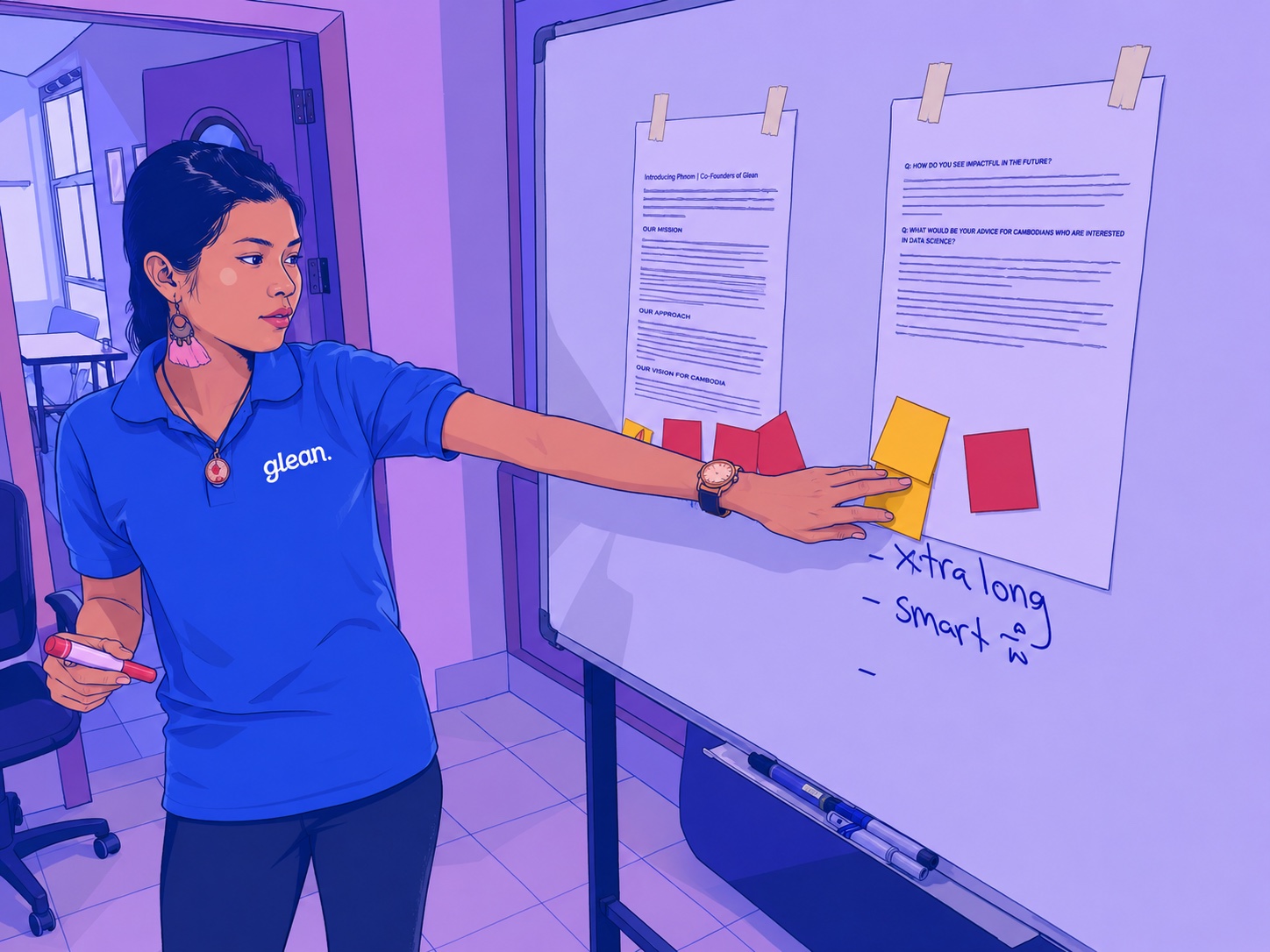
We ran the first research session with Transparency International Cambodia, who recruited 17 young women entrepreneurs matched to Pact's participant archetypes. Our two lead facilitators were Glean staff who are themselves successful Cambodian women entrepreneurs, which changed the room. The session ran two hours because these are working business owners and their time is worth something.
Every participant was active on Facebook. That confirmed what we'd seen in earlier work: Facebook is where Cambodian users already live online, so a tool that meets them there has almost no adoption barrier. When we asked about risk, they talked about public posts being seen by the wrong people in their networks. Nobody raised concerns about what a platform or a chatbot might do with their data. We took that as a reason to be more careful on their behalf, since the people we were building for weren't going to demand it themselves.
The service findings broke the hypothesis. Participants described tax filings that took several rounds to get right, so they hire agencies. The agencies have value because they know the processes inside out, and several women described paying for packages where a provider handles the whole legal obligation end to end. Some had friends who stepped back from formalizing a business because the paperwork felt like more than they could take on alone.
One Window Service is a genuinely good idea, and still, most of the women in the room didn't know what it could do for them. The working assumption was to hire trusted help rather than go through a process themselves. The need for clear, free, impartial process information genuinely exists. Nobody is looking for it, because a habit built on trusted help runs deeper than a missing document.
We dropped One Window Service as the launch content.
What we built instead
The same women told us what would help: knowing how to build a business, and someone to talk to about it. So we adapted an open-licensed startup manual for the Cambodian context, cut it to 35 pages of content and translated it into Khmer for the first time. That curriculum became the chatbot's content, delivered conversationally through Facebook Messenger on our Startup Mission Cambodia page, built on Chatfuel so we could read usage data and keep refining the flows. We added a mentor-matching function, collected the minimum data we could and put informed consent in front of anything we gathered.
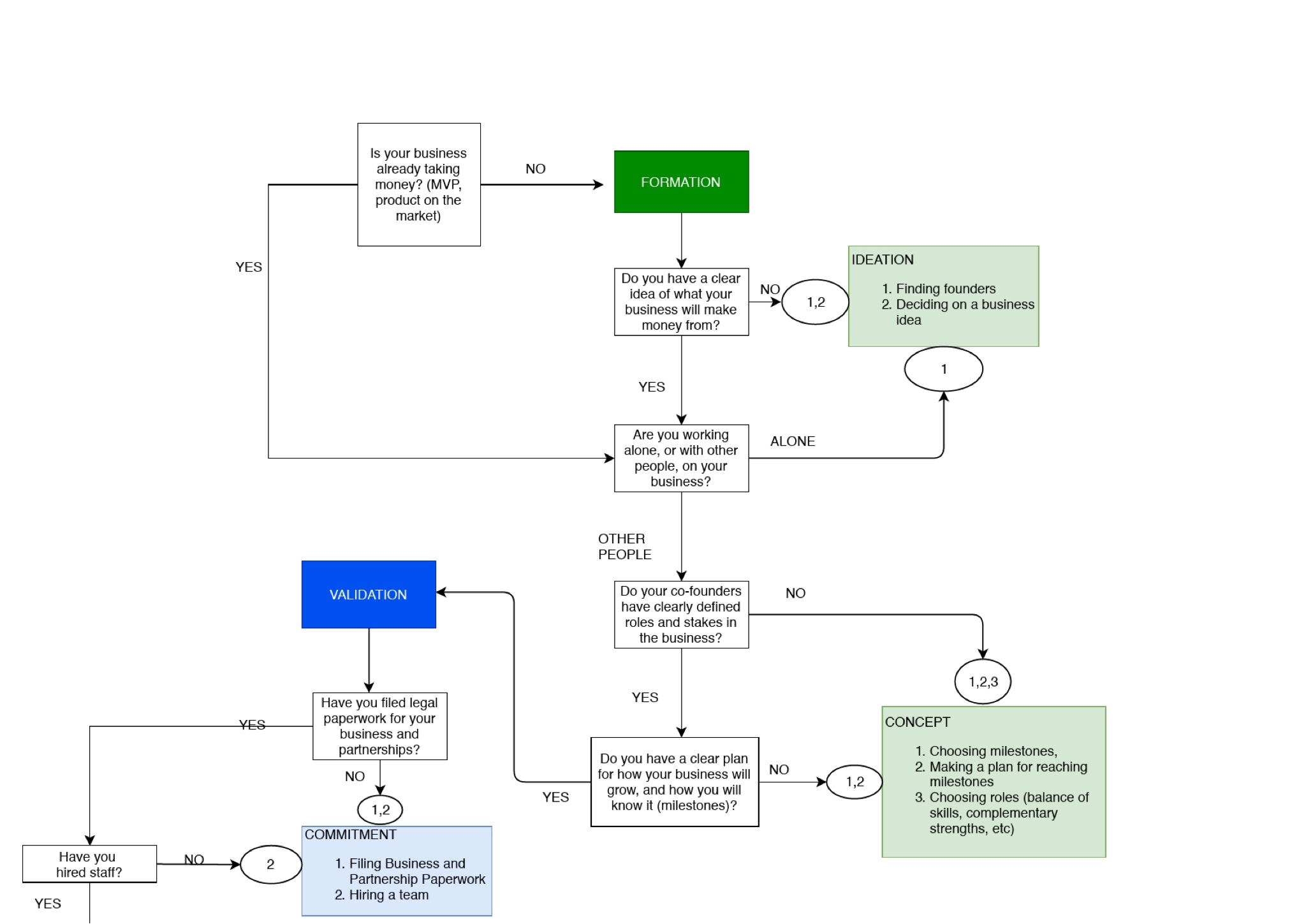 Module routing from the design work: a few plain questions place a founder in the right part of the curriculum.
A second round of sessions put the prototype in participants' hands. They wanted video, content for different stages of business growth, soft skills like goal setting and time management, and mentor profiles before committing to a match. We fixed the navigation problems they hit and reworked the ad content to pull more users from Phnom Penh.
What happened
The grant target was 1,000 users in four months. 3,414 people used the chatbot. 1,790 of them were women, and 18 percent of those women asked to be connected to a mentor. A quarter of users came back to the bot daily for five days after first touching it.
The mentor demand outran us. By the end of the grant, 324 women were waiting for a match and we didn't have the network to serve them. We followed up with every one of them and started building mentor partnerships through TI Cambodia and others, but we had validated a need we weren't resourced to meet.
What it taught me
A chatbot can hand someone a process. It can't hand them the trust that the habit of hiring help is built on. Any product aimed at that problem has to be designed hand in hand with the services themselves, or it's decoration.
We went in planning to deliver information. We left with a waiting list of 324 women who wanted a mentor. The information was the easy part.
Working on something like this?
Research, design or a good question. All welcome.