UXO720 - Week 3 - Who are our users?
I've started off a bit behind this week, still trying to catchup from Week 1. I had a small delay getting starting on this week's challenge as I wanted to finish more interviews for the project. My first set of interviews was too limited and I wanted to add an interview of a primary user who came out of the discovery meeting with Ian Jones, the founder of this new impact venture.
As I processed the affinity map from week two, I realized that we were missing a key segment of the customer base in our interviews: the procurement manager at the mid-to-large corporations in Cambodia. These users are a key customer, usually placing large cleaning supply orders for their company.
I interviewed Socheta a procurement manager for a mid-size company in Phnom Penh, Cambodia. With an annual budget of 3,000,000 a year, her office oversees the procurement of cleaning supplies for their five main offices in Phnom Penh.
A few interesting observations from this interview:
-
Mid-to-large companies are less price sensitive, but still use a best-price model for procurement
-
Orders a much larger in size, but tend to order less often than SMEs
-
Environmental impact was not a factor in procurement decisions
-
Smaller ad-hoc orders are typically reimbursed to the employee
From this interview I was able to develop a user persona that will help drive my design decisions going forward. I based this persona on a guide I discovered on digital.gov, the United States Government’s design guide. I also found their ‘How to Choose a User Experience Technique’ article helpful in understanding how the persona could fit into the overall design process (Sawant, 2022).
I’ve never really liked personas in design, as I always felt too much time was given to aspirational needs and objectives. But having gone through this process and basing this persona on the interviews I conducted, I think it has helped me better quantify who I am designing for.
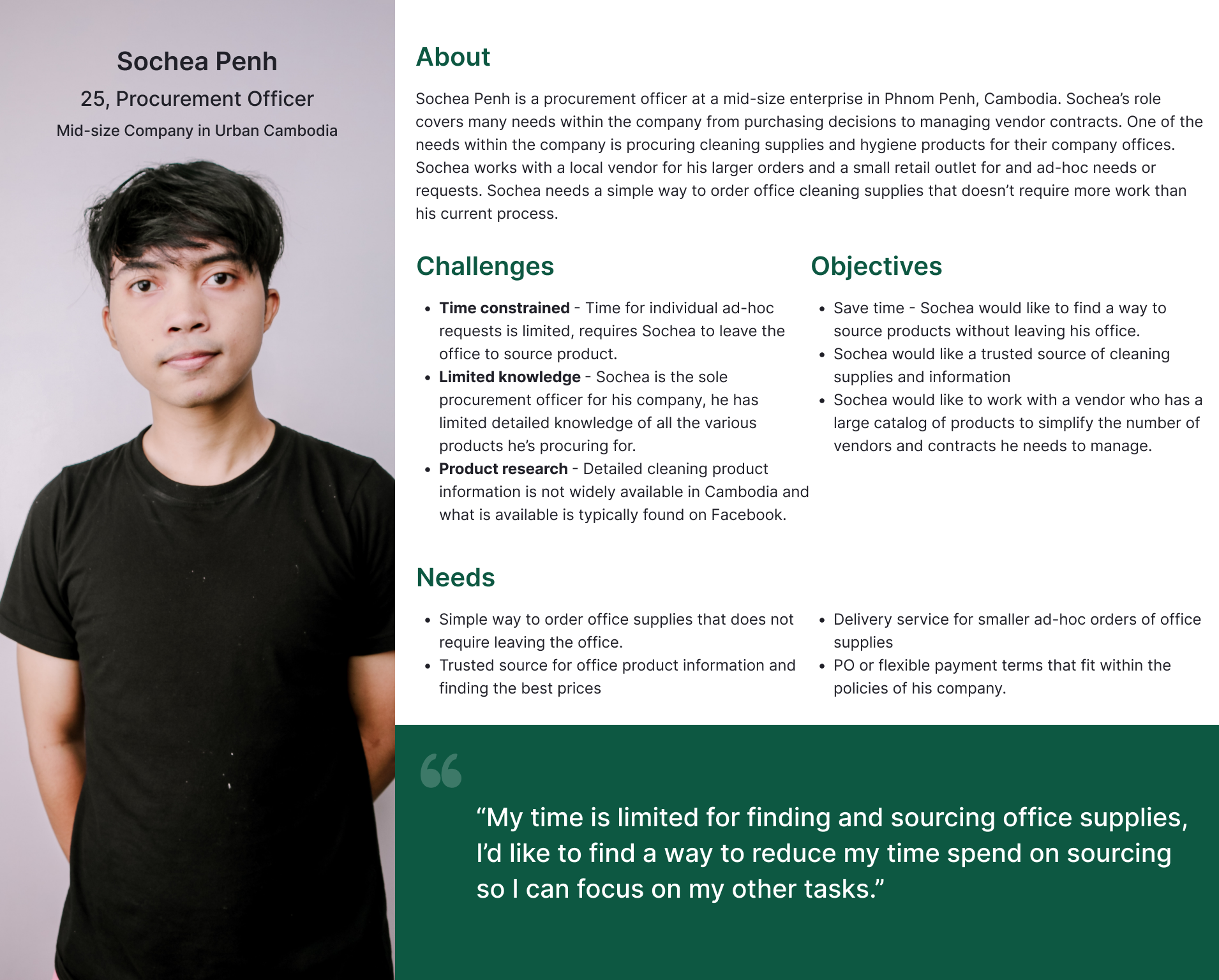
User Persona based on interview with procurement teams at target businesses.
Competitor Analysis
In addition to this interview, I spent time working on a competitor analysis, looking at three different natural or organic brands in Cambodia that sold similar products to MIV. I focused on a Pluses and Deltas model for the analysis since we are looking at areas in which we can help MIV improve upon what is available within the market already.
A few of the learnings from the Pluses and Deltas analysis:
-
Ecommerce looks to be a secondary channel for sales, competitor sites are broken, lacking information, and difficult to navigate.
-
None of the competitors reviewed emphasize the educational need within the space making it difficult as a consumer to understand why I should care.
-
Marketing copy was lacking, focused mostly on the product details, not the benefits
-
Ordering processes seem overly complicated
From this analysis, I wanted to focus on one element and see how the competitors implement and handle it. Based on the original How Might We Statement, our aim is to help inform, educate, and motive businesses to understand how their purchasing decision impact the environment. With this is mind, I believe by reviewing the product details page we can find opportunity to see how competitors are implementing this and how we could improve upon it.
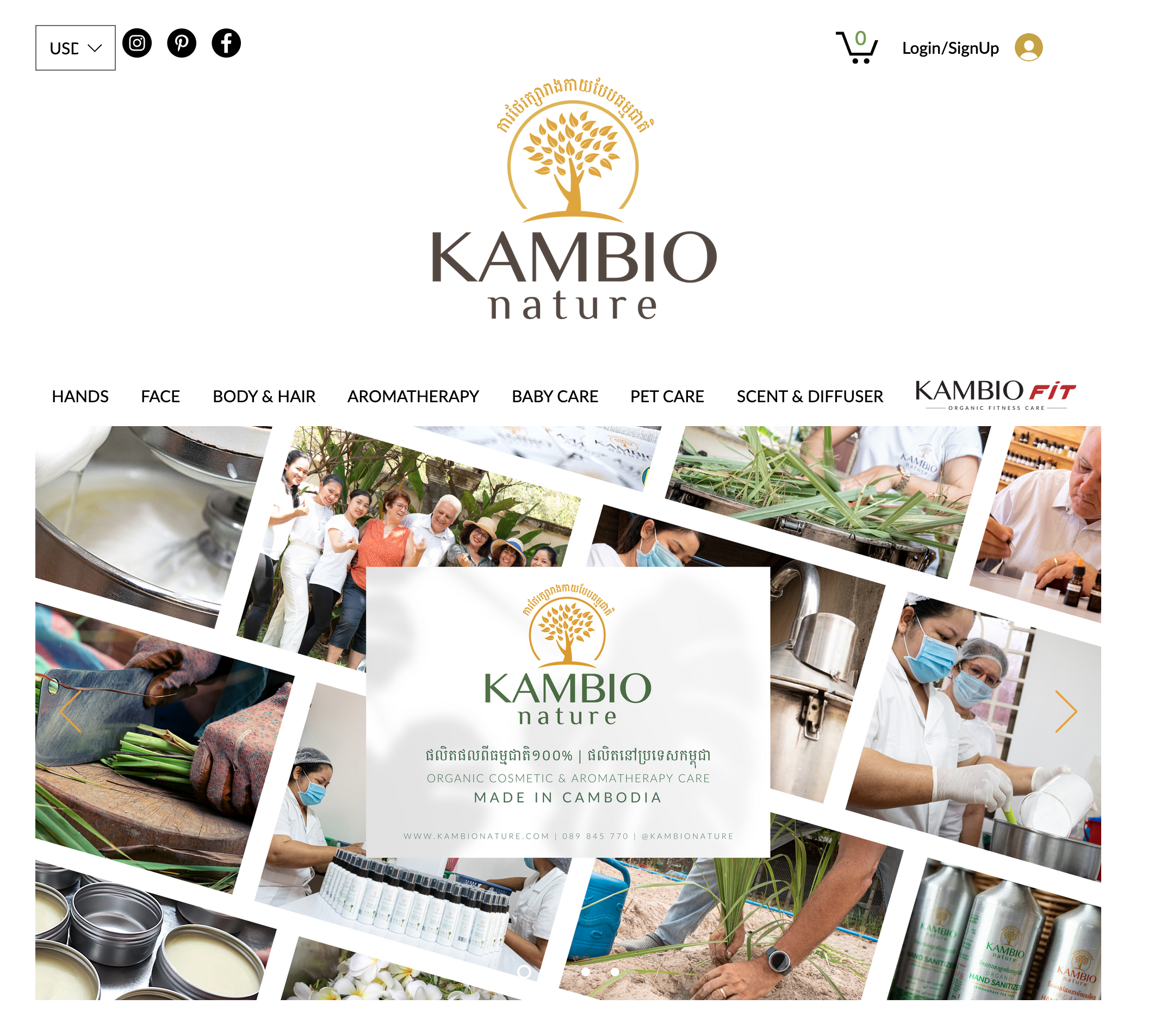
https://www.kambionature.com/is a primary competitor with a strong e-commerce presence in Cambodia. Their site has a large selection of products and the marketing appears to be well thought out.
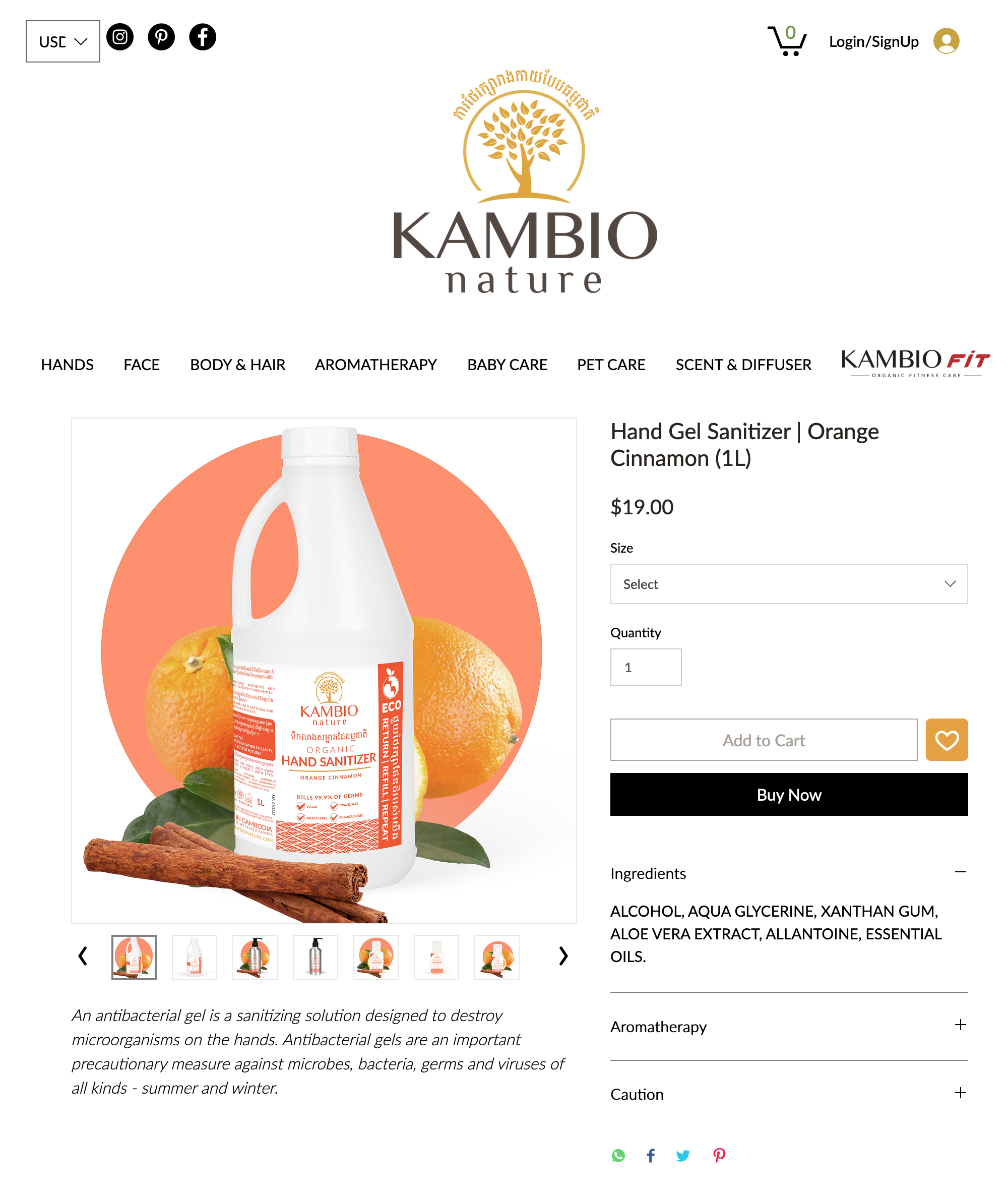
https://www.kambionature.com/- Product Details Page
The product detail page is well laid out with clean, high-quality product images. Their listing pages highlight the ingredients, aromatherapy usages (if applicable), and product cautions. Their product descriptions are clear and to the point. What they are missing is any information on the natural or environmental information about the product. Example of this could include: carbon offset, what ingredients are natural (or how to know they are natural), product impact, or impact measurements for the product lifecycle of the plastics.
Based on this review, MIV's competitors are not focused on informing and educating their customers as a key value add or marketing opportunity. Their product detail pages assumes a prior knowledge of what natural ingredients are and makes no effort to highlight the environmental impact of their products. If MIV wants to standout in this market, informing and educating as a key design component can add value to their offering, differentiation, and provide a better user experience.
Research on Empathy
I spend some time exploring the concept of empathy in design to better understand how I can use empathy in my work. This is what I’ve come to understand about empathy: empathy seeks to understand people. Its aim is to deeper our sense of who people are and how they approach the world around them. Being able to use empathy allows us to design better products or solutions for users.
Interaction Design Foundation phrases it like this: 'Empathy is important for us as designers and particularly for design thinkers because it allows us to truly understand and uncover the latent needs and emotions of the people we are designing for. As such, we can design solutions that meet the three parameters of a successful product or service: desirability, feasibility and viability.' (Dam and Siang, 2018)
Action Items
-
Based on the persona, start to draft a user flow for the site
-
Confirm with MIV the impact tracker concept
-
Review literature on impact metrics
References
Daniel, K., 2022. Personas 101. [online] Digital.gov. Available at: [Accessed 10 February 2022].
Sawant, P., 2022. How to Choose a User Experience Technique. [online] Digital.gov. Available at: [Accessed 10 February 2022].
The Interaction Design Foundation. 2022. Design Thinking: Getting Started with Empathy. [online] Available at: [Accessed 10 February 2022].