UXO720 - Week 2 - User Research
I have decided to conduct my final project on a social impact venture based in Cambodia called Mekong Inclusive Ventures. My friend has started up a new business model that focuses on reducing plastic waste, through providing refillable cleaning supplies to businesses in Cambodia. The aim is to have a website that tracks the environmental impact each customer has per-product purchased.
Their needs will be to design a ecommerce website that helps business owners understand the cost savings of using refillable supplies, but also the environmental impact they can have if they switch to MIV's product line.
As part of my research I wanted to explore the potential environmental issues around ecommerce. The increase in plastics in packaging, the carbon footprint of boxes, and the increase in emissions from delivery trucks must be having some type of impact. I found an Interesting journal article titled: "A review of the environmental implications of B2C e-commerce: a logistics perspective." After reviewing the journal article it's clear that more research needs to be conducted on this pressing issue.
The article concludes that:
In the last 14 years, the focus has progressively shifted from the mere identification of the wide-ranging environmental effects of e-commerce to the need for a quantitative evaluation of their impact, although much remains to be done in this regard. Some industries, such as books and grocery, have largely been addressed, however, promising sectors in the e-commerce field, such as clothing and consumer electronics, have only been considered to a certain degree. Moreover, despite the emerging role of multichannel strategies, the environmental implications of the related logistics activities have not yet been studied in detail. (Mangiaracina, Marchet, Perotti and Tumino, 2015)
While working on the problem and how might we question statements I need to consider the goal of single use plastics, I do not need to have the environmental impact of ecommerce as a primary indicator.
I am anticipating interviewing two different types of users for this activity. First, is the business owner, with the aim of understanding his goals for the digital platform. The second is the customer, the person who the platform wishes to engage with. These groups will have different needs and goals that the platform will need to serve, starting with the overall business goals and aligning those with the customer expectations.
My goal is to understand their problems, goals, and motivations.
These were a few interesting notes from the lecture this week:
-
Define the problem
-
Attitudinal - What people say, measure people's stated beliefs -> Behavioral - What people do, understand what people do with the product or service
-
Qualitative - How or why to fix a problem, learn behaviors or attitudes based on observing them
-
Quantitative - How many or how much - gather data about behaviors or attitudes indirectly
Post Interview with Ian Jones from MIV
A few observations about how the interview went with Ian:
-
Taking notes with also interviewing is very difficult, I did record the audio of the conversation to be transcribed with Otter.ai
-
Having your interview subject expand their thoughts or dive deeper on ideas is great, but it can draw out the interview process
-
We know, roughly, that the end product will be an ecommerce platform, but what that entails will be defined through this 12-week process
-
What's interesting about this brief is that I will get to help inform a new product strategy as we develop out the UX concepts
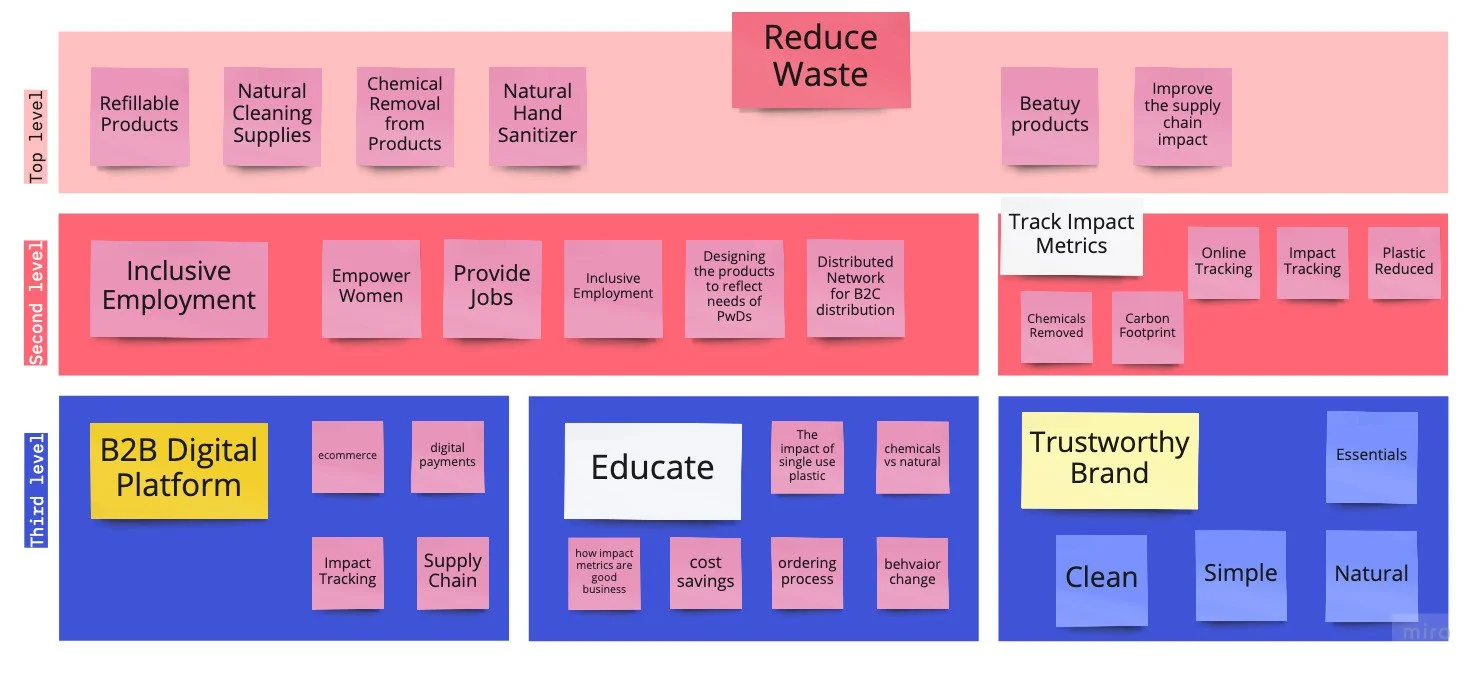
Affinity Map from the initial interviews conducted
Problem Statement, Hypothesis, How Might We Statement
Mekong Inclusive Ventures (MIV) is an impact venture and entrepreneur support organization in Phnom Penh, Cambodia. MIV focusses on creating impact businesses that use a decentralized model to create impact and provide self-employment opportunities for marginalized communities, in particular people living with disabilities in Cambodia.
MIV is developing a new business to help reduce single use plastic consumption by providing a plastic-free, natural alternative to cleaning supplies. Businesses can order refillable cleaning supplies and have them delivered directly to their office, reducing the number of single-use plastics they would typically order. To achieve their impact metrics, MIV envisions a digital e-commerce platform that provides end-users, partners, and their vendors a tracking system of how much plastic has been reduced through their platform. A specific emphasis will need to be on not only providing the impact metrics, but on how can MIV best inform and educate businesses on how their purchasing decisions can impact the environment.
Problem Statement:
"I need a simple way to order office cleaning supplies that have a positive impact on the environment."
Grace wants to learn about how her business can have a positive impact on the environment.
Grace needs a trustworthy place to order ethically made, sourced, or environmentally safe products for her business.
Hypothesis:
"By creating a simple to use commerce website that informs and educates businesses on how their everyday product consumption impacts the environment, we can reduce single use plastics"
How Might We
How might a digital platform help inform, educate, and encourage businesses on how their purchasing decisions impact the environment?
Action Items
-
Create a user persona(s) based on the interview with Ian
-
Review other websites in their market to see how they communicate about eco-friendly products
-
Academic research into how environmental impact is measured in e-commerce
References
Mangiaracina, R., Marchet, G., Perotti, S. and Tumino, A., 2015. A review of the environmental implications of B2C e-commerce: a logistics perspective. International Journal of Physical Distribution & Logistics Management, 45(6), pp.565-591.