UXO720 - Week 11 - Delivering a Case Study
This week was focused on how we communicate about the work we’ve done. We took a closer look at how case studies are developed and looked at some ways in which we can structure our case studies to be more effective. The most interesting part of the lectures this week was: “Articulating Design Decisions.” One of the challenges I face when talking about my work is how and what do I communicate about the decisions I make in my design process. I’ve realized over the last two modules that this critical reflection journal and learning how to reflect well is a key part of writing a good case study.
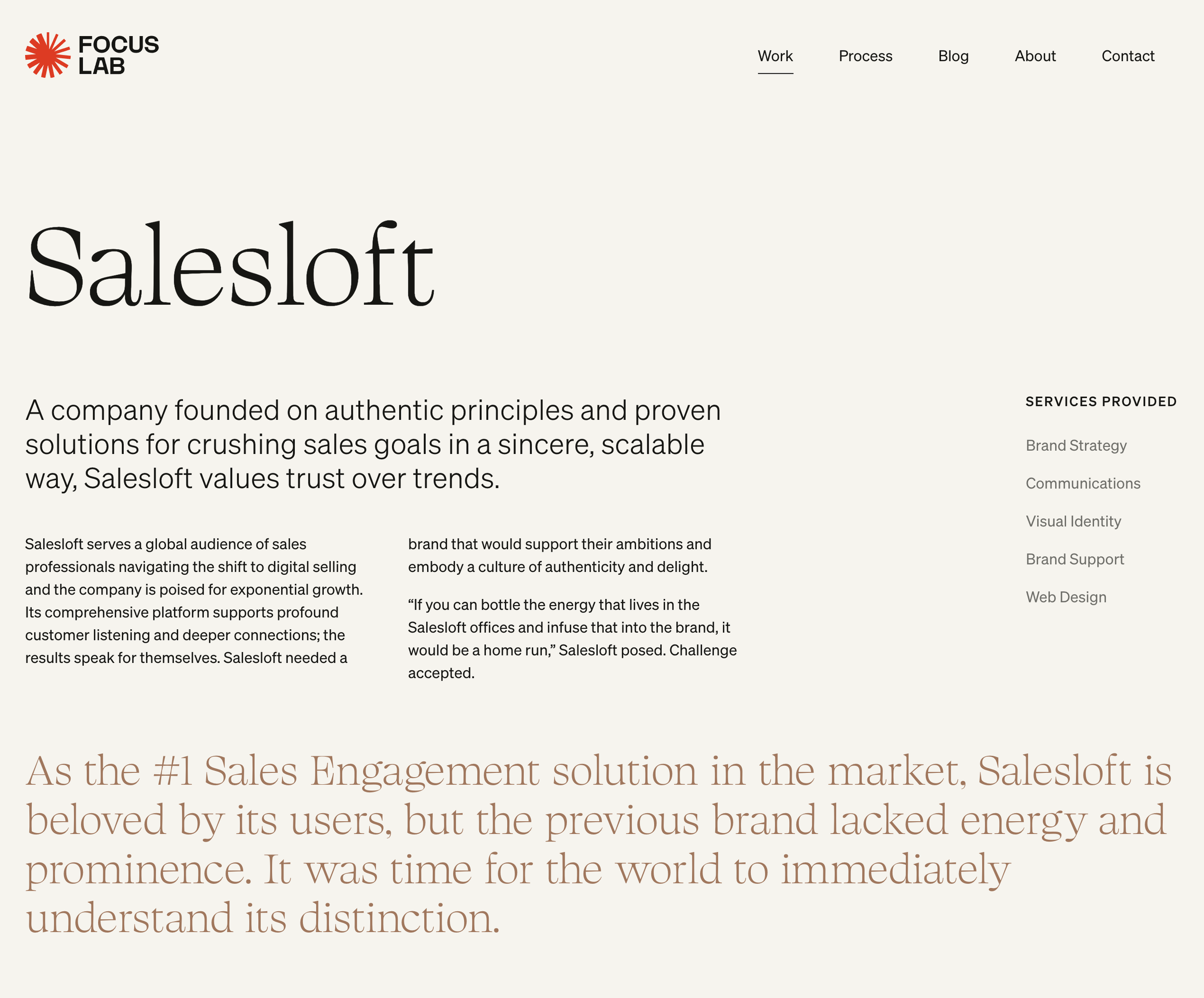
Focus Lab s has some of the best case studies!
I took time this week to start drafting my case study for the final project and I had a lot of feelings about this experience. First, I need to take better notes throughout my entire process of design. This journal helps with that, but I find myself only taking high-level notes as I move through my design. And I’m still not taking notes about why I am making certain design decisions. I tend to level everything at the high-level, forcing myself more work when reflecting after the fact. Second, I liked the provided framework for the case study, it helped frame on how I could shape the case study and pull from my CRJ entries to help fill in all the gaps. Third, visual elements help communicate your process. In the sample case studies I reviewed this week, the ones that stood out all had well designed graphics that helped communicate a complex idea. For example, instead of trying to communicate just in writing about a user flow, I could design a graphic that showcases what a user-flow looks like.
Over the years I’ve drafted a few case studies, some of which are on this website, but this week highlighted a few key areas for me to work on:
-
Use a framework
-
Take notes throughout the process to help in drafting the case study
-
Design purpose-built graphics to help communicate complex ideas or concepts
I’ve included my draft case study with notes below.
Action Items
-
Review draft case study, update as needed
-
Download images and graphics for final case study
-
Design final case study for submission
Jesse’s draft case study from week 11…
Mekong Inclusive Ventures (MIV) is a social venture fund that supports businesses that have sustainable impact in the greater Mekong Region. As part of their first group of startup ventures, MIV is launching a brand of sustainable cleaning products for commercial companies in Cambodia. As part of their core focus, MIV wanted an e-commerce platform and social impact dashboard tool that could compliment their work and track their products global impact.
This project explores the challenges of using e-commerce as a tool for reducing carbon footprint, while empowering business to make sustainable purchasing decisions. Mangiaracina, Marchet, Perotti and Tumino (2015) state, regarding the environmental impact of e-commerce, that despite the emerging role of multichannel strategies, the environmental implications of the related logistics activities have not yet been studied in detail.
The key deliverables for this project focused on two main outputs:
-
An impact tracking system that would allow for MIV to track their products’ global impact.
-
A friendly and approachable e-commerce website for environmentally minded business to purchase sustainable products.
Introduction
The Brief
Mekong Inclusive Ventures (MIV) is an impact venture and entrepreneur support organization in Phnom Penh, Cambodia. MIV focusses on creating impact businesses that use a decentralized model to create impact and provide self-employment opportunities for marginalized communities, in particular people living with disabilities in Cambodia.
MIV is developing a new business to help reduce single use plastic consumption by providing a plastic-free, natural alternative to cleaning supplies. Businesses can order refillable cleaning supplies and have them delivered directly to their office, reducing the number of single-use plastics they would typically order. To achieve their impact metrics, MIV envisions a digital e-commerce platform that provides end-users, partners, and their vendors a tracking system of how much plastic has been reduced through their platform. A specific emphasis will need to be on not only providing the impact metrics, but on how can MIV best inform and educate businesses on how their purchasing decisions can impact the environment.
Since arriving in Cambodia in 2011 I’ve been interested in exploring accessibly issues around technology. While this project is not directly tied to accessibility in terms of the technology designed, it will aim to benefit those working with disabilities at MIV. And this project will, hopefully, lead to more opportunities to explore how to make technology more accessible in Cambodia.
For the design approach and development on this project, I wanted to work through a design framework presented in the course, the double diamond model. This model helped shape the approach to the overall design and development of the prototype. Additionally, since I needed to interview and work with real users, I wanted to work on an approach that was flexible and allowed room for iteration, which I needed to do throughout this project.
Research
User Interviews
To start the design process, I started with three interviews to help inform the problem statement, my hypothesis, and finally a how might we statement. The first interview was with the founder of MIV, Ian Jones, to help get an understanding of the products they are creating and what he would like to see in an impact tracking tool.
[ Key Take Aways from Ian’s Interview ]
[ Affinity Map from Ian’s Interview ]
I interviewed Socheta Chhum, a procurement manager at a large wholesale supply company in Cambodia. Based on my interview with Ian Jones, I wanted to better understand the needs of the users who would be the target of the platform. The aim of this interview was to understand buying habits, why they picked the products they did, and what their understanding or motivations around buying environmentally friendly products were.
[ Key Take Aways from Socheta Interview ]
I interviewed the owners of a high-end hotel in Phnom Penh, Cambodia. This interview was to inform the design as a possible target demographic of the platform. Hotels purchase large amounts of cleaning supplies and might have a business motivation to promote their environmentally friendly products used.
[ Key Take Away’s from Hotel Interview ]
User Persona
After the user interviews I was able to start developing a user persona that would help inform my design decisions. The persona was largely based on the Procurement Officer at a mid-size company or hotel in urban Cambodia.
This processes helped me create a persona that would be usable for my project, with challenges and objectives mapped from user interviews. Typically, I’ve seen user personas that are made up from little to no research which limits their value. I did not want to repeat that mistake and not have my persona informed by real user feedback.
Competitive and Comparative Analysis
As part of my research, I conducted a pluses and deltas analysis of the existing product producers within the Cambodia Market. These included two e-commerce websites and a Facebook page, which is one of the primary e-commerce channels in Cambodia.
[ Draft Pluses and Deltas Chart ]
Outcomes:
-
E-commerce looks to be a secondary channel for sales, competitor sites are broken, lacking information, and difficult to navigate.
-
None of the competitors reviewed emphasize the educational need within the space making it difficult as a consumer to understand why I should care.
-
Marketing copy was lacking, focused mostly on the product details, not the benefits
-
Ordering processes seem overly complicated
User Flows
After the pluses and delta analysis, I wanted to draft an initial user flow. Before I started the user flow process, I did a Know Your Audience reflection to affirm who I was designing this user flow for.
Know Your Audience
The target consumer is a procurement manager or office are a mid-sized company.
-
What Motivates Them?
-
This consumer is largely convenience based, looking for a system or ordering process that is easy and saves them time and money.
-
Story matters if they are reselling or providing the product as part of their customer experience.
-
-
What's meaningful to them?
-
Trust with their vendors
-
Time saving
-
-
What keeps them following through on their intentions?
-
Their primary role is to procure these products
-
Desire to optimize ordering so they can focus on other key business tasks
-
Based on this information my initial user flow focused on designing the core flow for the e-commerce system. Having never worked on an e-commerce system before, I wanted to map out as many of the anticipated flow processes as possible.
Once I completed the e-commerce flow, I was able to pull back and focus on the key feature of the design, which was the impact tracker. I iterated two different user flows for the impact tracker until I found a version I was happy with. But I was still let with a challenge on where within the e-commerce flow would this fit.
I followed this up with an additional interview with Ian Jones to get his feedback on how he felt it could work. Based on Ian Jones’ feedback, I felt that it was best to incorporate the impact tracker on the product details page, allowing the user to interact when looking at making a purchase. This would also help the user focus on their ordering goal, while the impact is secondary, but available to them.
Problem Statement:
“Grace needs a trustworthy place to order ethically made, sourced, or environmentally safe products for her business.”
Hypothesis:
"By creating a simple to use commerce website that informs and educates businesses on how their everyday product consumption impacts the environment, we can reduce single use plastics"
How Might We:
How might a digital platform help inform, educate, and encourage businesses on how their purchasing decisions impact the environment?
Design
Design Studio
I conducted a design studio to help rapidly flush out my ideas for the impact tracker. The goal was to quickly sketch out six ideas with each sketch time-boxed to 1 minute each. At this point in the design phase, my concepts were based around an interactive tool that a user could interact with to see how their purchases impacted the environment. This was a challenge to find a way to get these ideas sketched so quickly, but I was able to take one of these concepts a bit further in the wireframes once I started to put this into a product page.
Wireframes
I started sketching the initial wireframes for the impact tracker. The first set of wireframes I developed were focused on the impact tracker and the larger layout elements of the product pages.
Information Architecture
I spent some time reviewing the onboarding experience for the MIV Impact Tracker and I concluded that I needed to continue to update and refine my user flow. I went back and worked adapting the user registration process to help educate the user on how this platform was focused on environmental impact.** **
Prototyping and Usability Testing
It was at this point in the design process that I started to run into challenges with my initial wireframes and user flow. I took the wireframes to three potential users and the feedback I received was a lot of confusion. The assumption we were testing is that users would be interesting in understanding how their purchasing decisions impacted the environment. But the reality for the target users is that positive environmental impact, while an aspirational goal, does not directly impact their business purchasing decisions. Diving deeper on this insight, I discovered that as long as the products were price competitive, knowing that the products where causing positive impact was a secondary buying decision.
Users were not interested in a long onboarding experience or being educated in the process of purchasing what they deemed as typical business purchases. This feedback was important to hear at this phase, so I could iterate the design away from the corporate buyers and focus on the tools that MIV needed to help begin the conversation of environmental impact.
With this feedback in mind, I went back to the wireframing process and sketched out an internal dashboard and simplified the impact tracker on the product page.
[ User Feedback ]
Visual Design
When looking at the visual design of the e-commerce brand and dashboard, I wanted to design a look/feel that would reflect the environmental nature of the brand as well as pay respect to the Khmer culture in which the brand was formed.
MIV provided me with their primary brand color, a wonderful Hunter Green, that beautifully captures the environmental nature of the brand. Using this as the base, I researched various color palettes through Coolers.co. The secondary color I landed on was Olive, which has a slight hint of gold tint. This color pays homage to the Khmer culture in which the brand was founded, as gold is used throughout Khmer historical designs.
For the typography I went with a typeface that is modern feeling, aiming to communicate a forward-thinking approach to the environment and e-commence. Poppins is a clean, sans-serif typeface that is simple, clean, and had the organic look I was going for.
There are two main design tracks for this prototype: the public e-commerce website and the dashboard/order management system for MIV.
For the design of the e-commerce website, I wanted to keep overall design simple. MIV will only have three products at launch, and I didn’t want to over design the store for more than three products. Originally in my wireframes and initial design I planned on a much bigger catalog of products, but I was able to pull back the design to only focus on the three main products. The focus for the e-commerce site was to explore a simple homepage, catalog, and product page. Additionally, I wanted to design the interface for registering a new user into the system, through a four-step process.
For the dashboard and order management system, I wanted to design a relevant way for users to see how their orders are creating environmental impact, which would start the behavior-change on how the user perceives their product consumption. Additionally, I wanted to think through what order management looked like in a developing country like Cambodia where order tracking would need to be processed through couriers rather than standard post services.
Prototype
One challenge I faced when working through the design of this prototype was thinking about how to make the end prototype feel realistic. I like working with Figma for designing but as an interactive prototype I felt like there was more I could do with this. I decided to use a Webflow to build out the responsive website and dashboard from my Figma designs. I like Webflow as a rapid prototyping tool since it allows me to edit visually, like Figma, but also allows me to better build web experiences for testing.
And it was within testing on the browser that I had to make a lot of rapid changes to my design as not everything translates well to the browser and not everything I designed worked well on mobile. But by using Webflow and working across the responsive pages I was able to make acceptable compromises between my design and what was possible for mobile usage. One example of this was the tables for the dashboard view. On a normal web browser, you have a lot of extra space for data and information. On a phone this is a much larger challenge and having to determine what you should hide is a difficult trade off in terms functionality. For order status on my dashboard design, it came to the point where the orders were just not useful on mobile since I could not display any information beyond the order number and total price.
It became clear to me through this process that design and development each have their compromises and building a design to work across devices is a very difficult challenge.
References
Focus Lab®. 2022. Salesloft. [online] Available at: [Accessed 28 April 2022].