UXO720 - Week 1 - Orientation
It's the first week of a new module and I am feeling out of touch! After such a long break, winter break, I've realized I enjoyed my freedom in the evenings. But getting back into this module on UX should be exciting as I love UX and have been waiting to dive deeper on the topic.
This week's learning sessions were very good, focused mostly on the high-level of what is UX and various frameworks available (I do love a good framework!) . Speaking of frameworks, my aim here is to keep following the Gibb's Reflective Framework for these articles. I found it most helpful for finding and articulating my thoughts about the week's experiences.
For our first Spark Forum this week we were asked to share: "For this Spark forum, think about what user experience (UX) means to you. Try remembering about your recent (say within the last month) experiences of using any products or services – how could those experiences help you define user experience (UX)?"
Upon reflection over the last week, I have a few different user experiences that I could pull from and I thought it would be good to talk about a recent bad user experience. I run a small invoice software product for service professional in Cambodia and I've been working on adding digital payments through the local banks. I have done this type of work before, using Stripe (www.stripe.com (Links to an external site.)) or similar processors. Typically the process is very straight forward, I read some documentation, look at some code samples that fit the language I use, then hook in my app to their system. If I have an issue I can consult a FAQ to better understand what my problem is. The process is very streamlined, organized, and transparent. I have never needed to talk to anyone, or email anyone to get the code working, it just works. The entire process takes about a day or two to complete.
It's not this way in Cambodia. After emailing the bank for information on setting up our app, we had to send them a presentation on our tool, how it works, and our customer profiles. Then once they approved us they sent us over a 100 page legal document outlining all of the policies for using their system. Next they gave us access to their website portal, which had outdated documentation, no sample code, and an FAQ that answered very few of our questions. Finally we were added into a Telegram group with their team, which consisted of 12 different people who we were there to answer our questions. And if there was anything in this entire UX process that was broken, the biggest one was trying to understand how to use Telegram for getting setup. There is no search within the conversations, random people are sending us PDF files, random questions got lost amongst the other conversations happening in the chat. It took almost two months of work before we were able to finalize everything and much of that was us going back to fix items that were lost within the chat, files we lost, or threads we missed.
This example showed me a stark contrast between two different companies that prioritize a user experience and how that can make people feel using their product. Stripe has spent a lot of effort to understand the user journey, to map out the needs, and find a way to give us an interface the meets those needs. The local bank doesn't have that same priority, which as a user makes us feel like we are not valued, and that they just don't care.
Additionally, there were two interesting prompts during the lessons that I thought were helpful for me to respond to:
Prompt: Think about what UX means to you, what of the things we talk about in this video interest you about it, and why you wanted to take this course.
For me, UX means how someone engages with something. Understanding the process that a user goes through, be it physical or digital, to achieve a desired outcome. I think it's common these days to think of UX as only digital, but it also covers physical experiences like paper-based forms. I'm wanting to explore more areas of UX to become more well-rounded as a designer. I've been very interested in content design and how we can create good copy that meets the needs of our users.
Prompt: When we talk about the different UX competencies, think about what you may have done before, and what you think you might enjoy doing.
I've worked across a few different competencies in UX. I started my career as an interaction designer creating flash ads for the automotive industry. After the iPhone killed Flash, I moved to visual design, focusing on websites and mobile apps. Most recently, I've been working on user experience research methods, trying to help understand how Cambodian's use their mobile devices. I think I would really enjoy exploring UX research as a main practice of mine.
Lastly, for the challenge activity we were asked to interview a partner about their desk setup with the aim of helping prototyping out some potential solutions. The goal was to conduct a basic interview, gather some insights, and refine those insights into a practical set of solutions for our partner.
Thoughts and Feelings
I started off the week behind, I was at an offsite for my work, but thankfully my partner Dieter and I were able to connect via WhatsApp to conduct our interview. While not ideal for an interview, I felt like we made the best of it by sending our questions in a Word document to be answered.
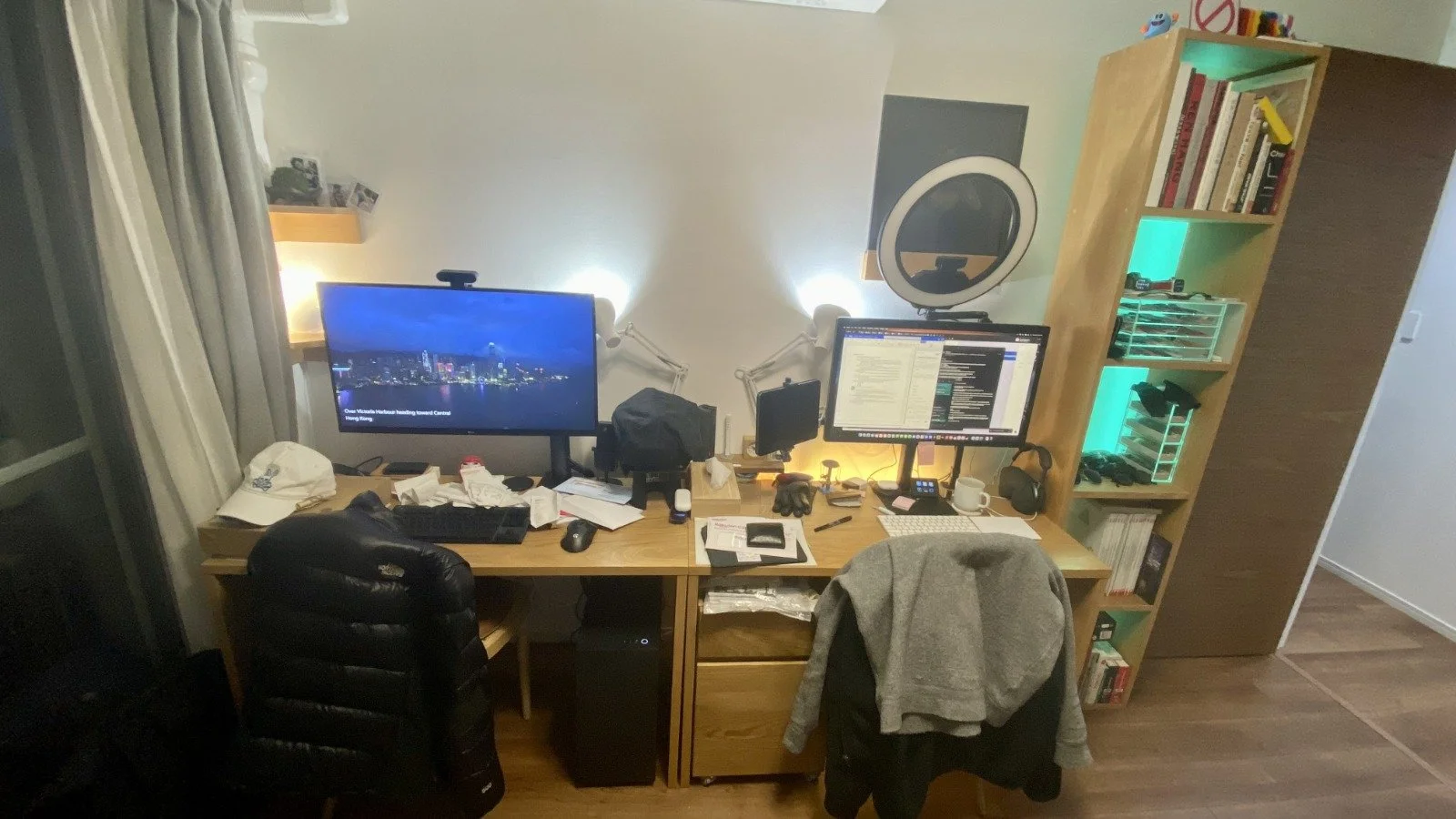
Didier’s desk setup for challenge week 1
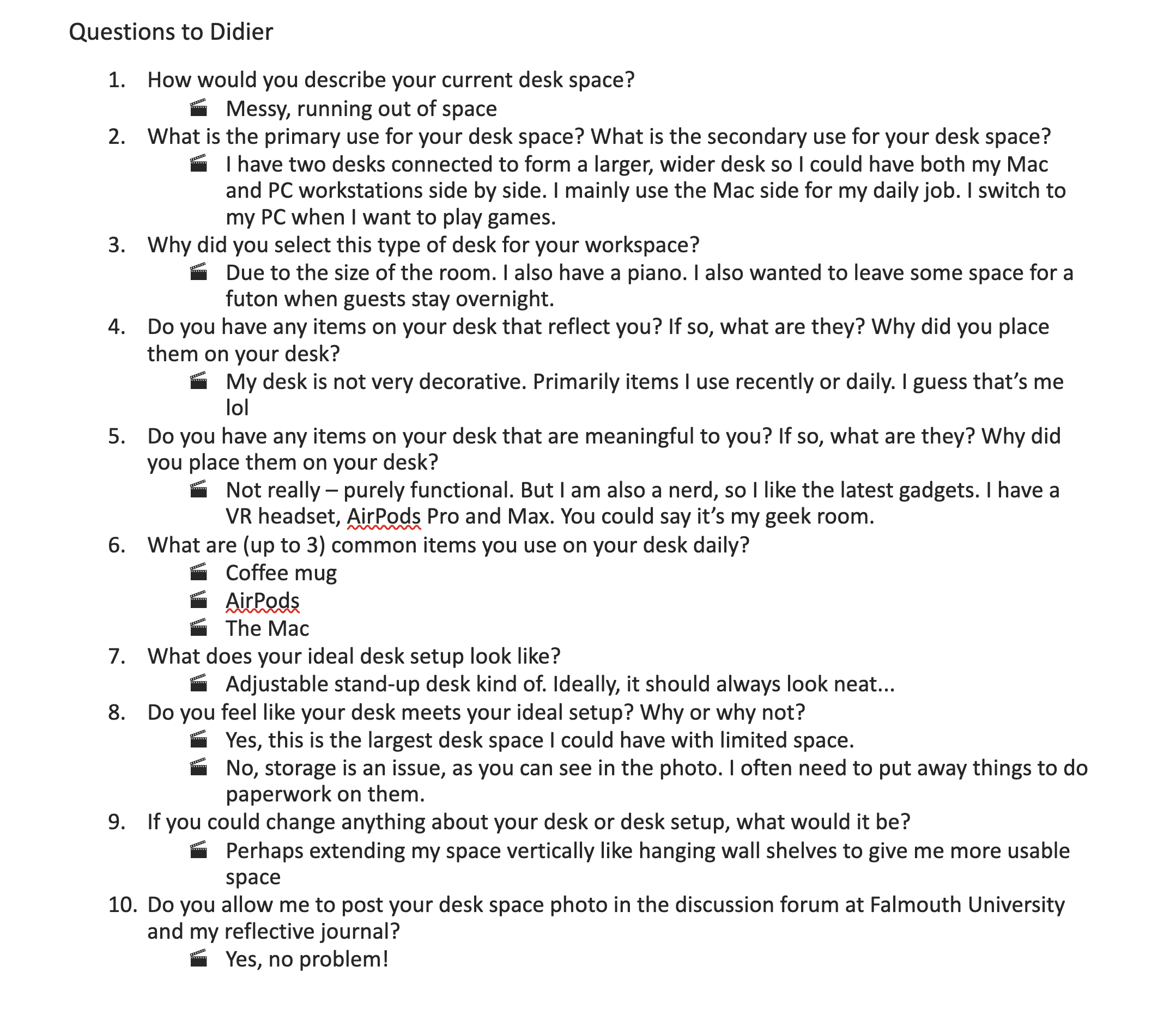
My final 10 questions for my partner.
It felt a bit like cleaning the cobwebs off my interview skills since I haven't been able to conduct a user interview since the start of the pandemic. I had a bit of a challenge coming up with the initial draft of questions. Ultimately, I was able to draft 10 questions I felt would help be better understand Dieter's desk needs. And since I am just coming out of GTO710, which included a lot of ideation and solution mapping activities, I felt much better once I started to map out Didier's responses.
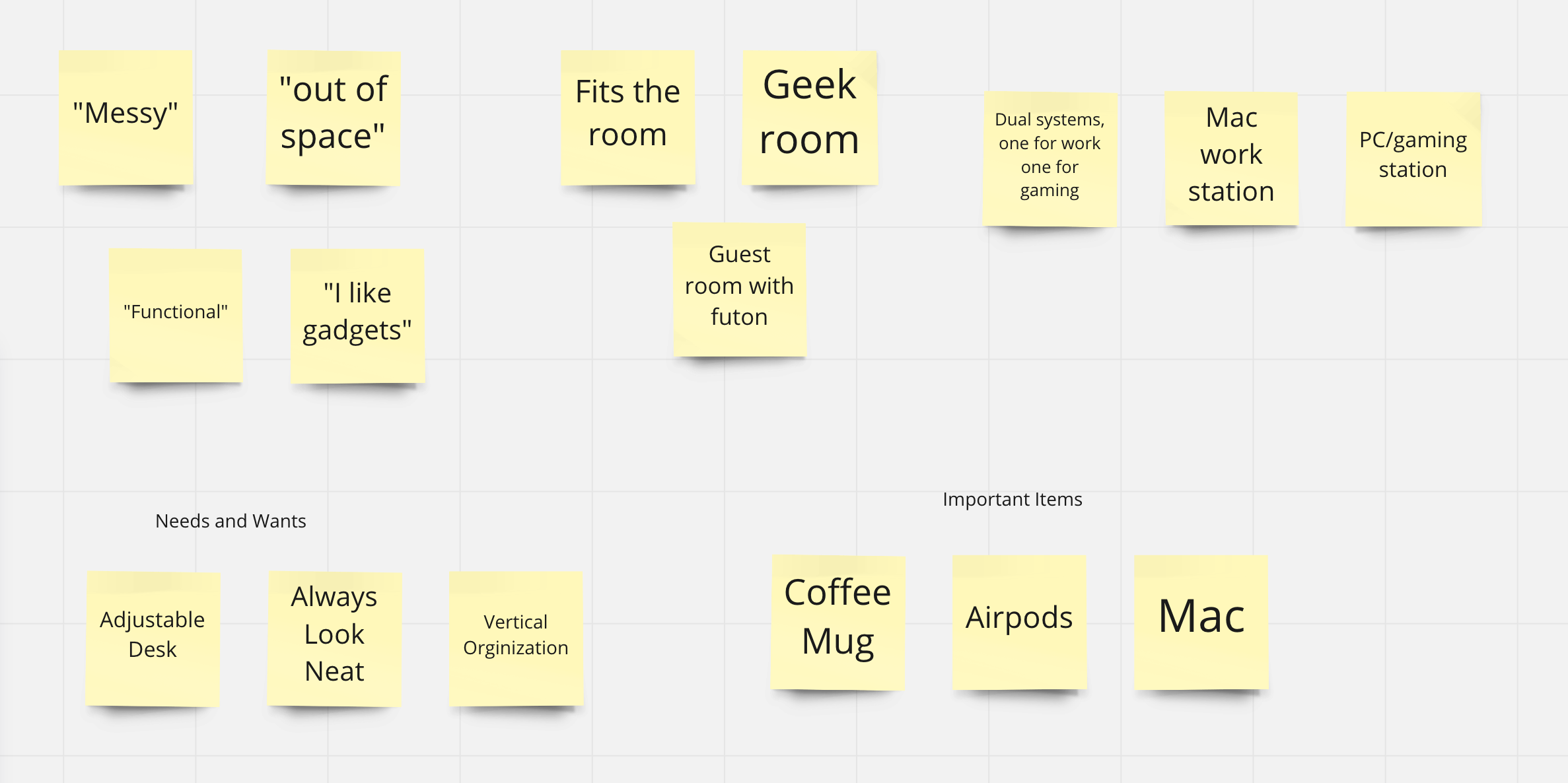
Mapping out Didier’s responses to my questions.
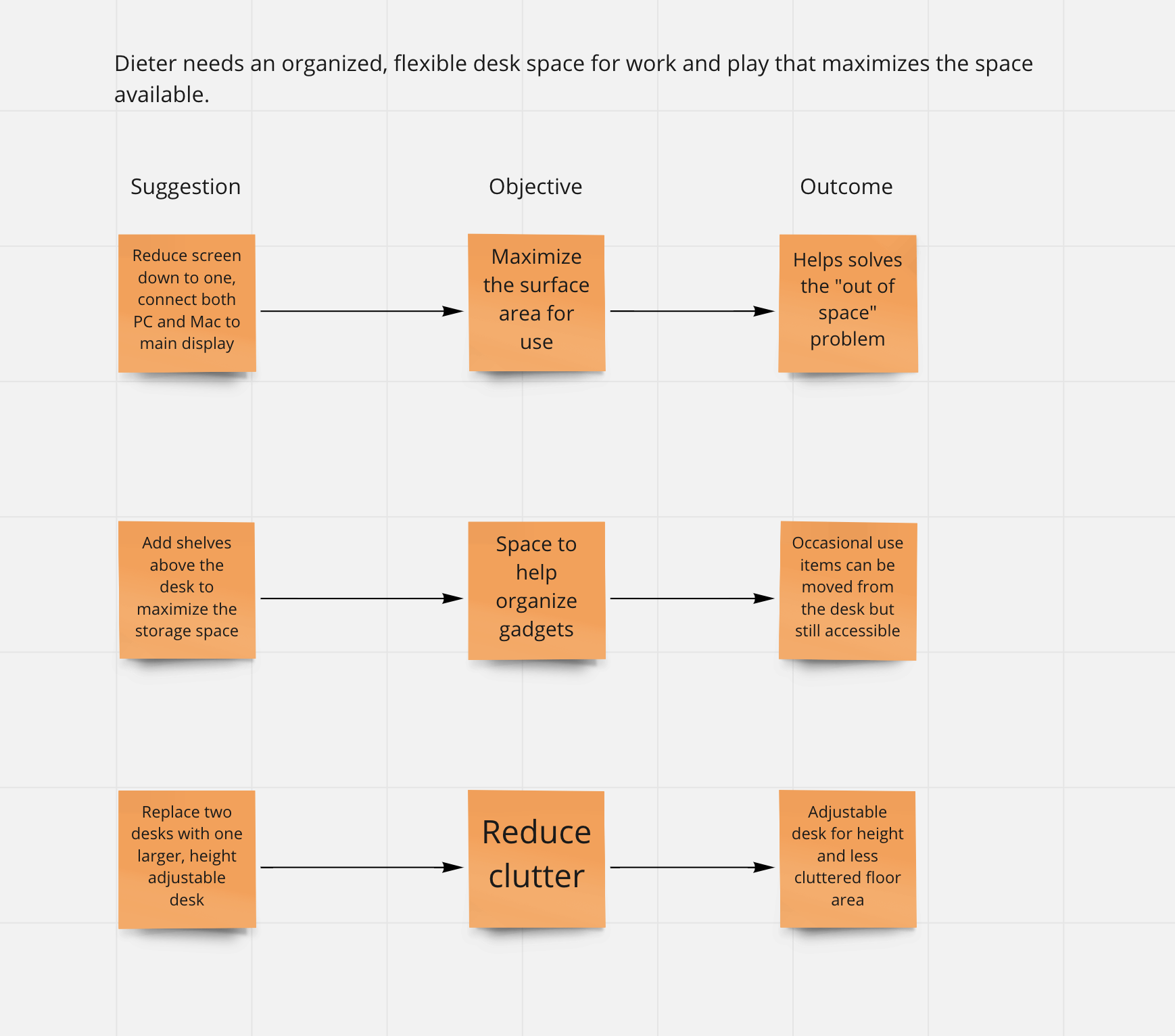
A problem statement with three suggestions on how to improve his space.
Overall I felt good that I was able to draft a usable problem statement and provide him with three opportunities to impact his desk setup.
Evaluation
From the start of this module I have been behind, which is not something I am happy about. Last module I struggled with time management and I wanted to take a different approach for this module. But life does happen and I will work hard at the end of week two to get caught up on all my work.
I also struggled to get moving on the interview questions, it had been awhile since I had conducted an interview so that was a challenge for me. But going through the lessons helped me get back into designer mode. I appreciated the focus on the double diamond framework (Design Council, 2019), which I had seen, but not personally used before.
Analysis
Looking at the overall week, lessons, and challenge I think this was the perfect amount of work to get back into the swing of design after a long break. I was able to draft design questions related to Dieter's desk setup, I took some time to explore design frameworks, and explored two academic articles on design based on my interest.
Conclusion
As I explore where I want to head for my project in this module, I took the time to research two academic articles. The first is an article about participatory design with people with disabilities in Cambodia (Drain, Shekar and Grigg, 2018). This area is of a special interest to me as I have been working in Cambodia for over a decade and I've seen how little accessibly is considered in design.
The second area I am exploring is design thinking and how it can help foster innovation (Tschimmel, 2012). I have been using human centered design for the past five or six years, working with NGOs in Cambodia to design better technology interventions. This week gave me space to dive deeper on reading about different approaches and the opportunities available to us as design practitioners.
Action plan
There are a two areas for me to look at next week as I move forward:
-
Narrow down the ideas for the final project and draft a brief for approval.
-
Create a video summary of week 1 content and experience
References
Drain, A., Shekar, A. and Grigg, N., 2018. Participatory Design with People with Disability in Rural Cambodia:The Creativity Challenge. The Design Journal , 21(5), pp.685-706.
Design Council (2019). What is the framework for innovation? Design Council’s evolved Double Diamond. [online] Design Council. Available at: [Accessed 28 Jan. 2022].
Tschimmel, K., 2012. Design Thinking as an effective Toolkit for Innovation. In: XXIII ISPIM Conference: Action for Innovation: Innovating from Experience. [online] Available at: [Accessed 1 February 2022].