GDO710 - Week 7 - Version Control
This week we learned about the importance of version control in our work. We were asked to setup a new repo on GitHub for our rapid iteration artifact.
Feelings and thoughts
I felt good about this week's lesson, I have been developing professionally for about 10 years now and Git is a tool I use daily. I was extremely familiar with the process and was able to setup the initial repo easily.
Evaluation
Since I was able to setup the repository quickly, I wanted to explore a few of the other tools listed. Git Kraken is a tool that I have heard of, but never used. I'm a bit of an old-school command line guy, but setting up Git Kraken to some of our more complex projects, with a lot of contributors was very interesting. Having a clean GUI to be able to see the various branches, merges, and conflicts is very helpful. A common issue is attempting to keep our local up-to-date with the constant changes, especially if you need to revert a commit.
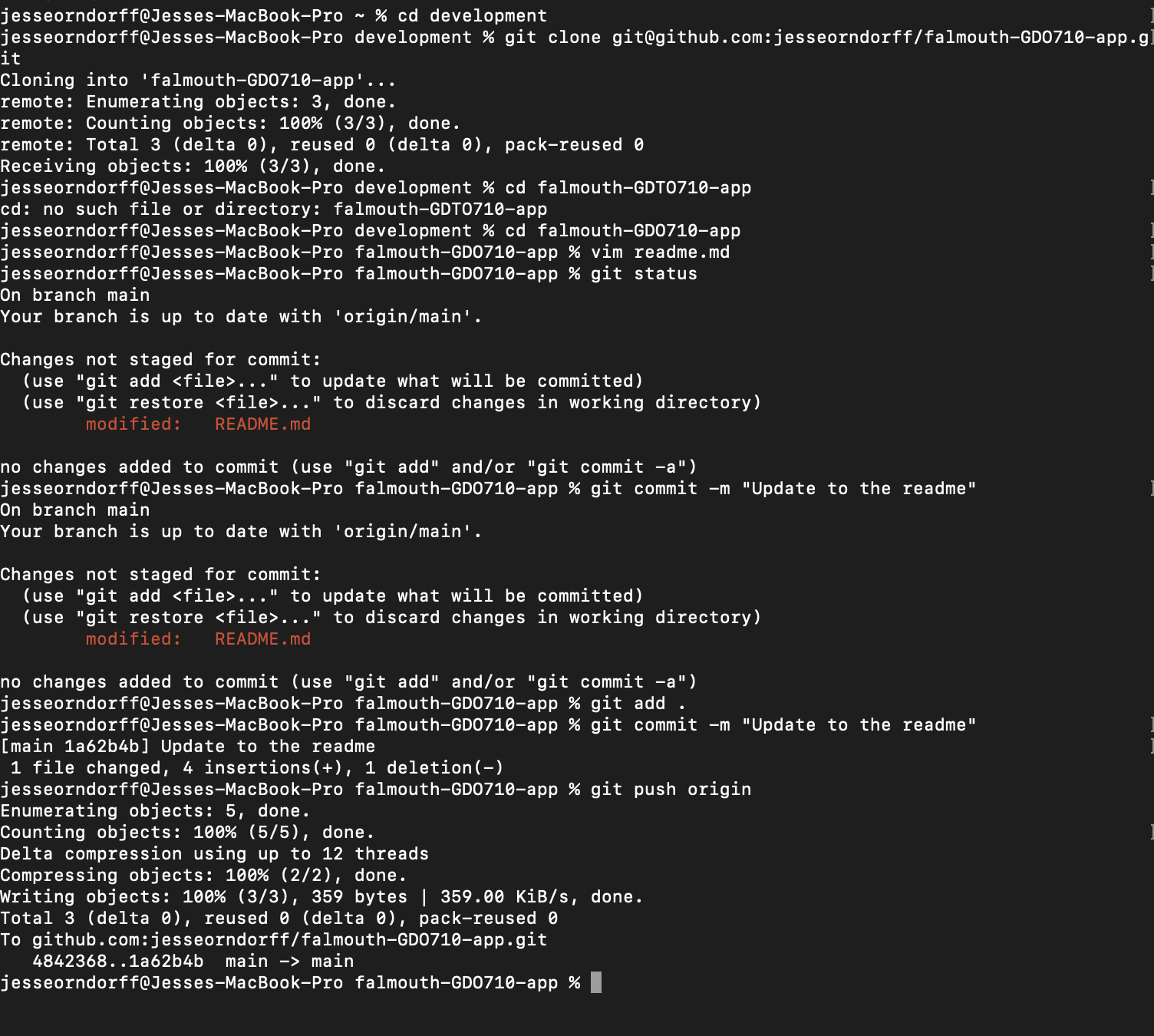
Git Clone and Git Push a few changes to the repo
Analysis
The need for version control in our work is incredibly important. I remember working as a designer in the mid-2000s and we not having a simple version control system for files was a huge issue. We would end up with multiple versions of the art files floating around between designers, often times missing the latest approved changes. Dropbox and file versioning was a big industry change when it allowed for file histories and managed conflicting files. Dropbox was widely adopted at the agency so we could better track file versions and see who made the latest changes.
As a developer, version control is industry standard and gives us the ability to have many developers working on the same code base, same files, so we can resolve and manage conflicts within the system. It is far from perfect, as anyone who has had to issue a "git revert" command knows, but it is much better than having to manually track the changes.
Conclusion
I'm still not sure how version control will contribute to the UI/UX industry. The tool makers seem to be taking this seriously, Figma for example includes files revisions. It seems like there is still plenty of opportunity to innovate on version control systems for designers.
For my research goal, I focused my efforts on conservation and technology since that is closely related to our project brief. I read a very interesting journal article titled: "Digital platforms: mapping the territory of new technologies to fight food waste." The article was a very interesting overview of the opportunities for technology in the food waste space. One of the key observations for me was: "Food waste is clearly a complex issue with a multitude of factors that can be approached from different perspectives. In this study we suggest that, based on the review of the literature and the analysis of web apps, blogs and platforms, the solutions to surplus and food waste both from the environment of the entrepreneur and the consumer employ the new technologies in the final phase (consumption) and have their major effects locally, due to the characteristics of relationships established locally” (Cane and Parra, 2020).
I find it interesting that most of the digital solutions contributed to a local effects, rather than larger systemic changes. I wonder what types of tools could be scaled to effect the larger systems? I would imagine that it would take larger corporations implementing some type of standards based tooling on the production side to help limit waste in the food process.
While this is a fascinating challenge, I will not take this on for my project this week. As I look forward to starting my project work, I will continue my work on my previous app. The original aim of the app was to allow for children to learn about and adopt virtual animals that are on the endangered list. With this extra time this week I will see if I can use the SCAMPER technique to remediate it into something usable.
References
Cane, M. and Parra, C., 2020. Digital platforms: mapping the territory of new technologies to fight food waste. British Food Journal, 122(5), pp.1647-1669.