GDO710 - Week 10 - Agile Practice
This week we focused on Agile Practice, with the aim of being able to understand agile in creative contexts, learn about the envisioning process, and apply Agile estimation techniques. This week included a challenge of designing a user persona based on one of our previous rapid prototypes.
Feelings
I've spent the last three years working on understanding Agile methodologies in software development. At my work we use Agile Scrum methodology to plan and deliver our client's software development projects. This week was a good refresher in a few different ways, most notably in estimation techniques. In my experience, since Agile leaves a lot of space for organizations to implementing it in the best way for their use case, each person's experience with Agile implementation is different. This week filled in a few gaps in my knowledge, I was thrilled that the course covered story points as well as it did. Story points has been something I've struggled to understand over the years and how it fits within Epics and Sprints.
Overall, I enjoyed the content this week and it helped build a deeper understanding of Agile methods.
Evaluation
I think the content and activities did a good job of helping to highlight Agile and the overall vision of the methodology. The Envisioning section was especially helpful for those of us that work in product planning. Based on the content this week, I started to develop story points for my personal projects. I found this article particularly helpful:
I struggled to get my persona done on time this week. I went through the content and wanted to use a framework I developed at my agency for persona building, but I realized it was too complex for this use case.
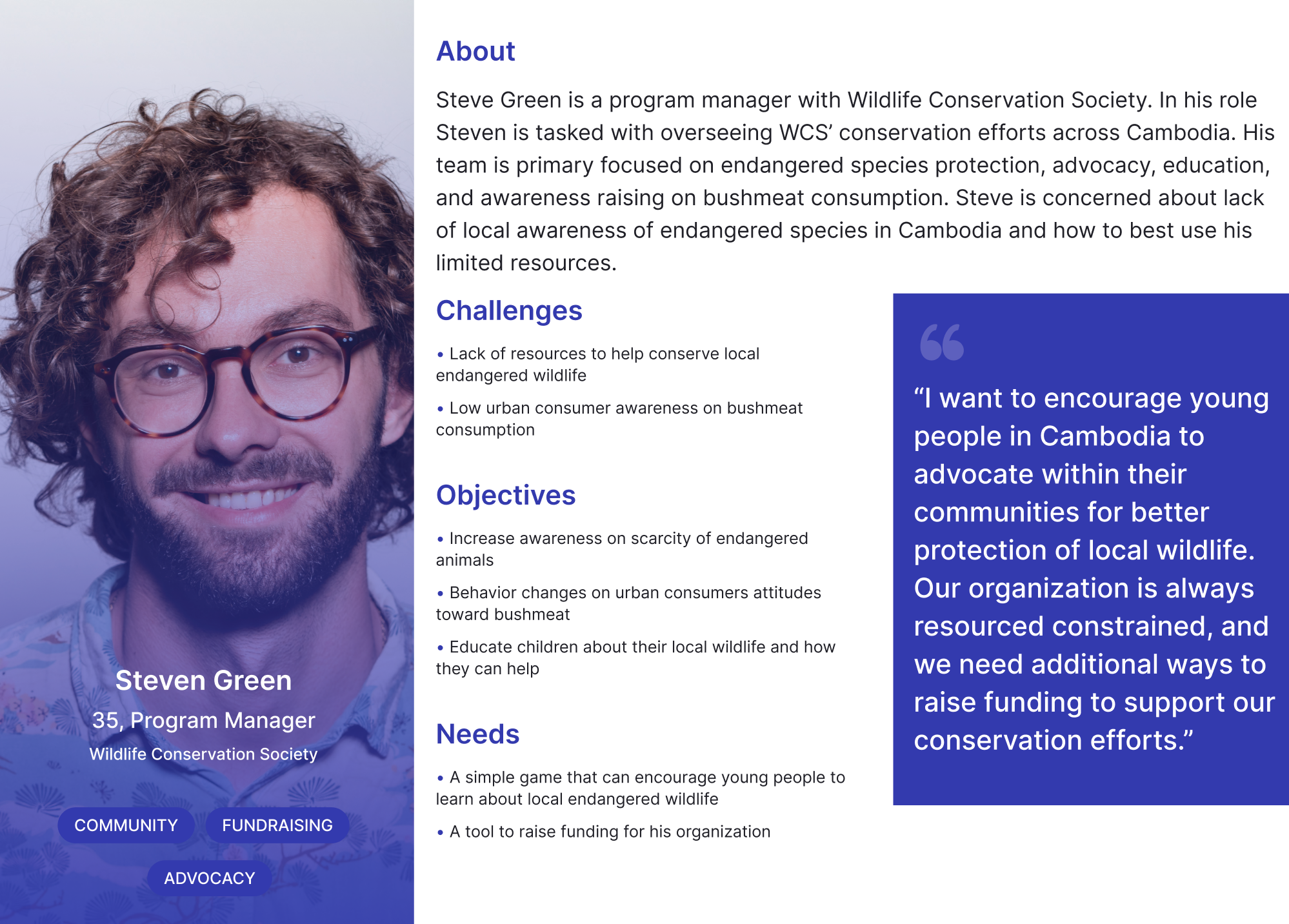
Meet Steven Green, Program Manager at Wildlife Conservation Society
I worked on a persona based on my second rapid prototype: Endangered the Game! The concept was to build a simple game that also teaches about local endangered wildlife. In my research on endangered species in Cambodia, I found an interesting report on the illegal bushmeat practice in Cambodia and how that is contributing to some of the reduction in wildlife in Cambodia (Knight, 2018).
I focused my persona on a program manager at a wildlife conservation organization. I felt this would provide the most interesting needs and objectives as they would be multi-faceted. In this case my persona, Steven, is focused on raising funds for their work, educating young people about the animals they are protecting, and encouraging behavior-change for those that participate in the bushmeat trade.
Analysis
I personally have never really liked personas as a general design tool. I've always felt like designers get caught up in building complex personas with characteristics rather than focusing on real challenges and needs.
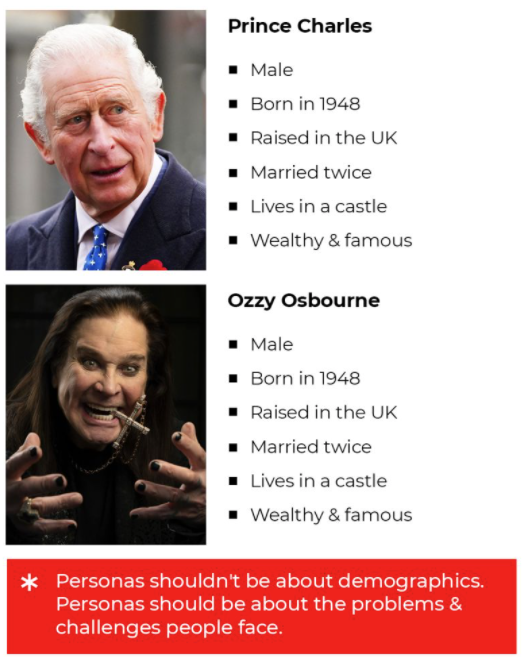
Found on Twitter. Source: https://twitter.com/carlosredondo
Personas can have assumptions and bias built into them and can be hard to filter out. I believe it's important that our persona development process incorporates feedback loops. These feedback loops are key to helping us reflect on our design bias.
Conclusion
The Agile Methodology is a very important part of a designer's work and knowing it will help us prepare for working in the technology and innovation market. This week was another great reminder of that even if you know a topic well, there is always room to learn more, or fill in any missing gaps you might have.
(Silva et al., 2020)
References
Knight, T., 2018. Eating to extinction – Urban appetite for bushmeat sparks wildlife crisis in Cambodia. [online] Fauna & Flora International. Available at: [Accessed 30 November 2021].
Silva, D., Ghezzi, A., Aguiar, R., Cortimiglia, M. and ten Caten, C., 2020. Lean Startup, Agile Methodologies and Customer Development for business model innovation. International Journal of Entrepreneurial Behavior & Research, 26(4), pp.595-628.