GDO710 Week 1: Orientation
This was the first introduction week to our course "Development Practice". Most of the focus this week was around helping us get situated in the online portal and ready for the work we are going to be doing over the next 12 weeks.
This week I want to explore the differences between the sprint method and the waterfall method. Then share a small creative activity, creating an avatar.
I shared for my introduction:
"My name is Jesse and I am American, but have been living in SE Asia for the last 10 years. I'm married and we have three wonderful, crazy, kids (5,3, and 1). I own a small technology consultancy here in Cambodia (www.glean.net) and we mostly focus on technology research, human-centered design, and software development for the international development space (ICT4D).
I've been very interested in taking a course like this for a number of years now. We were doing field research at a floating village here in Cambodia and I noticed everyone had a smartphone! They were rowing their boats to a vendor with a car battery to charge their devices! I realized, we knew nothing about how this village was using these phones. So I became very interested in user research methods and how we can do better UI/UX research. So I guess that's one of the main drivers of taking this course.
I look forward to meeting, working, and learning from you all throughout this course!
Sprint Method
The introduction module this week focused on helping us understand the difference between the Waterfall and Sprint project management methodology. The reason for this seems to be that the course is divided into smaller sprints over 3 week periods.
I see why the sprint approach would be a good methodology to use in our course work. The nature of learning, creating , seeking feedback, and producing an artifact fits nicely in with the Agile Methodology. Personally, I have spent a lot of time working with the Agile project management approach. I've used a few different versions as both a developer and a team lead at various other roles I've held over the years.
I look forward to exploring how using the sprint method as it applies to education.
Waterfall Method
The other project management methodology that was introduced was the waterfall method. The waterfall method is a linear project methodology that cascades across the seven different stages. It is a more rigid process than the agile method, which makes it appear not as good of a method for a creative module like the current course.
I just recently was involved with a project in Japan where the waterfall method was used. It was my first time being exposed to this method practically. And while the method is rigid, I can see why companies, especially larger, more traditional groups would choose this method. In the waterfall, there is no question about where the team is at, or what phase is happening. Everyone is working with the same delivery mindset and looking at the same product specifications.
Now that I have used both methods, I find that I enjoy using the sprint method more than the waterfall method. But I do have a new found respect and understanding for the waterfall method and can see when it would be a good choice for a project.
Creative Artifact
As part of our assignment this week we were tasked to find items that represented us and create an avatar. This is what I created:
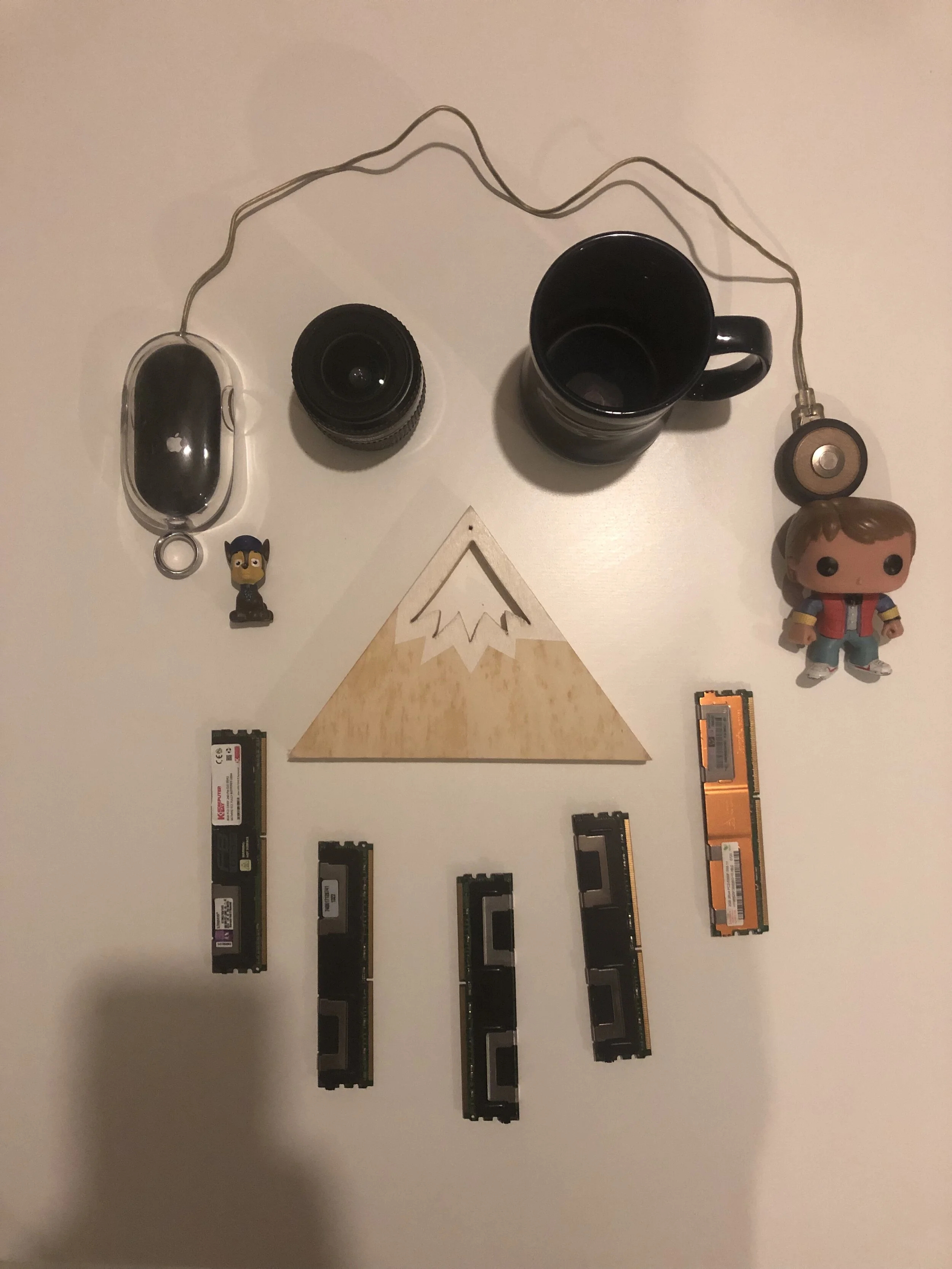
"This was a fun way to start the course! I took some extra time to ask my daughter what to include in this and she said "computer stuff."
Starting with the computer parts, the old RAM I took from an old Mac Pro and the older Apple mouse taken from an Apple Cube, both are computers that I am restoring. I added these because I started using a Mac in art school in the early 2000s and it was from that moment where I became obsessed with how things, especially technology, is designed. I now work hard to find old Apple computers to restore and love working on anything from that early 2000s era, especially the original iMacs.
The camera lens represents my past, I was a professional photographer for a number of years, and it was at art school that I was introduced to graphic design and the possibilities of merging my love of computer and interest in design and art. The coffee cup is my favorite cup and helps me be productive at work and in life! I love everything about coffee, from the beans to that first sip in the morning, it is bliss. I've also included a few toys, one for each of my children, the Paw Patrol toy, the round wheel, and the Marty McFly funko pop. I love seeing my children be creative and nothing allows me to see their imagination at work more than when they play with these toys. The mountain for the nose/mouth area represents where I come from. I grew up in the mountains, skiing and snowboarding. The mountains are a place of peace for me, once of the few places you I can get away and just be. I live in South East Asia now, so I miss the mountains deeply, only getting to see them every four or five years.
And the last item is my wedding ring. My wife has been deeply supportive of all my crazy ideas and dreams. I wouldn't be able to do this course without her support and encouragement."
Going forward with these critical reflection journals I am going to be focusing on exploring new creative techniques. I want to experience new ways to explore ideas, ideate, and capture creative output.