GDO710 - Rapid Ideation Session 1
The first rapid ideation session of the course was based on a randomly selected image, similar to how many game jams set their ideas. The card that was randomly selected was what appeared to be a young child pointing a sword at a shy, but friendly, looking dragon.
I spent some time on a brainstorming activity to get the ideas out of my head. I used a simple mind map to get help explore the potential idea paths. Below contains the initial list of the ideas that I brainstormed:
-
Slaying your dragons
-
Attacking your challenges
-
Facing your demons
-
Small vs big
-
Juxtaposition
-
Spikes
-
Fire
-
Hero
-
What if the dragon is the hero… (Opposite of the perceived meaning?)
-
Facing depression
-
Depression tracking tool
-
Mood / Mental health tracking tool
-
Game where creatures can only advance behind you (shadow game)
I wanted to explore these ideas in more detail and pick the most interesting and something outside my normal working area. To achieve a this, I created a short criteria for ideas:
-
Idea must incorporate a new technology I haven't used before
-
A novel concept that I have not worked on before
Based on the simple criteria I developed I reduced the list of ideas down to these four concepts:
-
Mood tracking tool
-
Game - Mechanic is creatures only move after you when you're not facing them. (Similar to the Ghosts in Mario)
-
Conservation / Tracking App for Komodo Dragons
-
Adopt a dragon AR app
After reviewing the top ideas, I wanted to focus on something that would be: an idea that focuses on positive social outcomes and is applicable to the Asian context in which I work.
While reviewing news articles related to the topic of "dragon" I came across a news article highlighting that the International Union for Conservation of Nature shifted the Komodo Dragon from vulnerable to endangered (Hannam, 2021).
Based on this new development, I decided to focus on an app that helps with animal conservation. I feel that this application would be very different from what's been done in this market before and would present a few interesting design challenges.
The challenges/questions that this project aims to explore are:
-
Would children enjoy taking care of a virtual animal?
-
What are the needs conservation groups have with building awareness?
-
Can an app help conservation efforts?
Research
Before I started sketching out a mockup, I needed to do some initial research on what has already been done in the conservation space. In 2017 the main technology interventions for conservation were focused on data collection, monitoring, and mapping of resources. Augmented reality was highlighted, but mostly as an idea to help build empathy of gamers (Palminteri, 2021). Additionally, gamification has been highlighted as a novel attempt at encourage engagement with conservation efforts (Dellecker, 2021).
AR Technology Research
My initial idea was to incorporate augmented reality (AR) animals that children could adopt, they would then need to take care of them by feeding them. After reviewing the tools available it seemed entirely possible to build a basic prototype using simple AR. The design considerations for developing an AR prototype would be:
-
Do I have the skill to implement this technology?
-
Does this technology fit within the time constraints?
I reviewed the following AR platforms for testing:
After reviewing the AR tools and platforms, I realized between ideation, wireframing, and rapid prototype I would not have much time to learn the new technology needed and implement it within a two week period. Instead I decided to focus on a simple app prototype that would use very simple illustrations to test the concept.
Wireframes
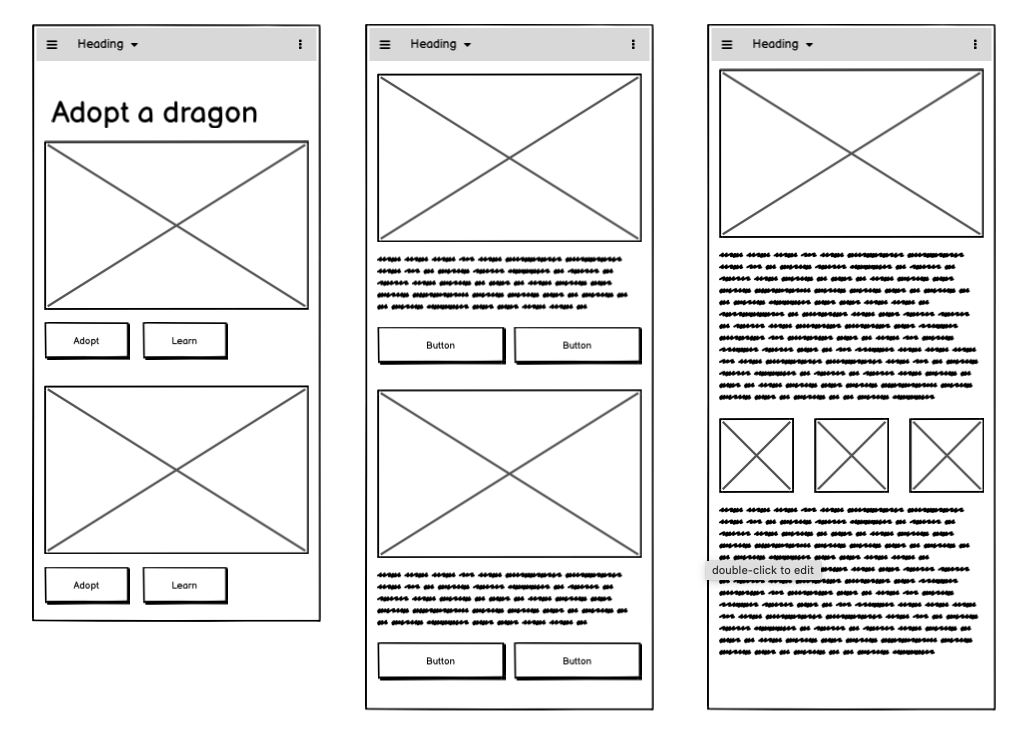
I started my wireframing process by creating low fidelity artifacts in Balsamiq, the goal was to explore what elements would be needed. I enjoyed using Balsamiq, it was my first time using the tool and it made wireframing simple.
Prototype
Moving to the functional prototype, I started to work with Figma to bring shape to what I had sketched out during the wireframing process. I chose to work in Figma since that was a tool I understood already and would not require any additional learning.
I needed to find some reasonable illustrations I could use to use within the app. I found these creative commons illustrations that would work well:
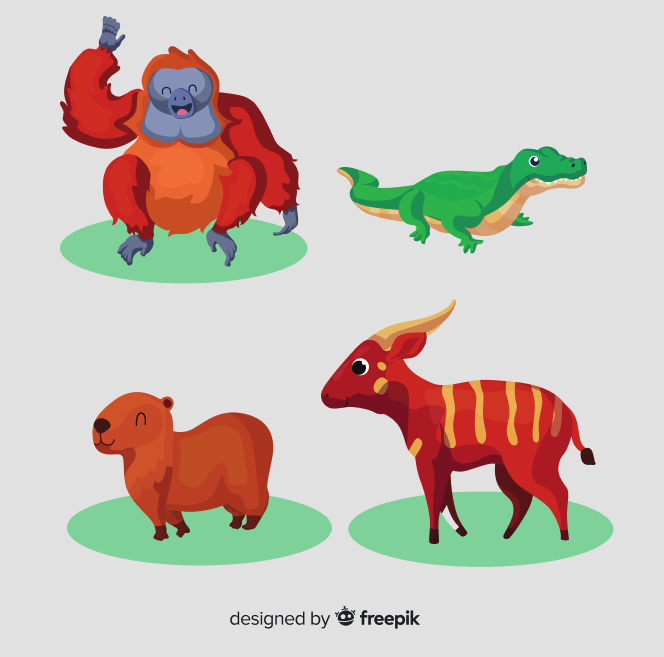
Nature vector created by freepik - www.freepik.com
I worked to find a color palette that included cool, natural colors.
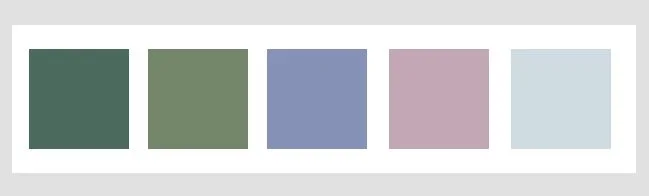
Color palette for Adopt-a-Dragon
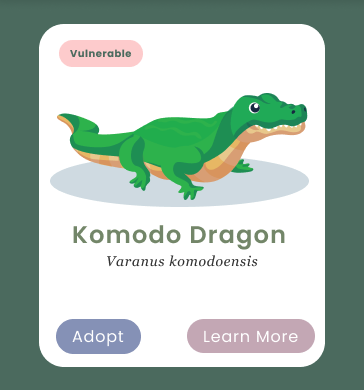
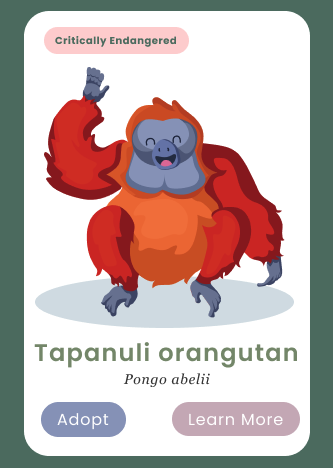
From here I worked to bring the wireframes into the new app design, attempting to balance all the elements. I started with a simple card design for the information panels:
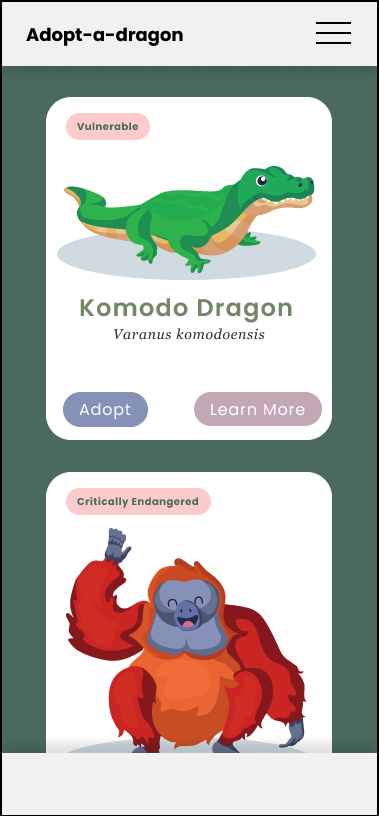
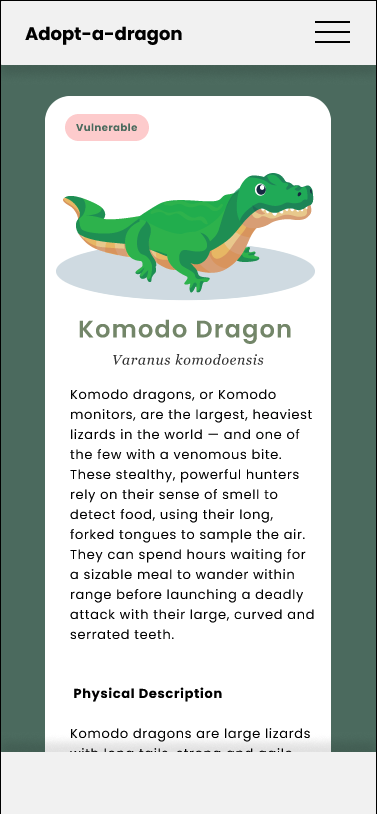
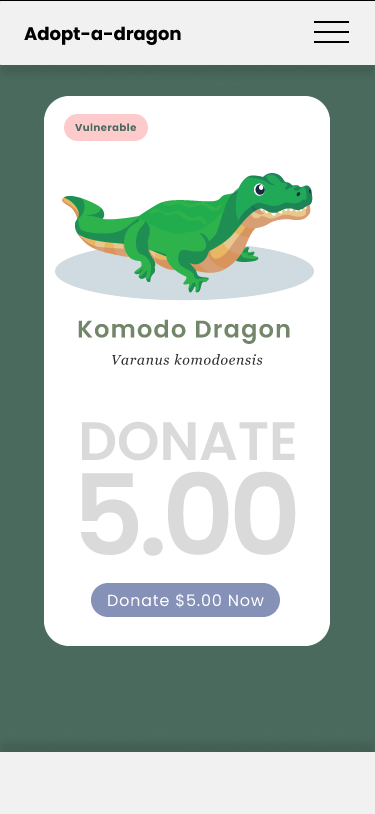
From there I worked to layout the three screen flows:
Lessons Learned
I have spent a lot of time reflecting on this project, mostly on what didn't work, and where I went wrong on my assumptions. First, my initial time and resource scoping of the project was significantly off. I vastly underestimated the amount of time I would need to conduct initial research, sort and filter ideas, and wireframe the concepts. For future projects, I need to provide myself a more detailed list of tasks and identify any potential time blockers or wasters. This would help mitigate scope creep and allow myself the ability to work through a more comprehensive to-do list. I did not get as far as I wanted on this project, which ended up limiting the scope of my prototype to only 3 screens, with no real flow. If given the opportunity I would want to revisit this project and try to find a way to implement an entire user journey.
Second, my focus for this project was mostly on the final output. I really wanted to explore VR as a possible solution for this and got stuck on the idea. Although we were told to use the time constraint to our advantage, I focused on what I wanted to do, rather than what the time would allow. By letting the timeframe influence the end goal, I could have better focused on a novel mechanic or idea rather than spending too much time moving in the wrong direction.
Third, I have learned that this course is asking us to reflect on our creative process. It is helping us better understand why we make the decisions we do and how we can better approach them in the future. Going forward it will be important for me to focus on the process, rather than the final prototype. My goal is to seek to understand what works in my process and what does not work.
Final Prototype
References:
Dellecker, A., 2021. How gamification could revolutionise conservation | Luc Hoffmann Institute. [online] Luc Hoffmann Institute. Available at: [Accessed 25 October 2021].
Hannam, P., 2021. Komodo dragon joins the list of endangered species. [online] The Sydney Morning Herald. Available at: [Accessed 25 October 2021].
Palminteri, S., 2021. 10 top conservation tech innovations from 2017. [online] Mongabay Environmental News. Available at: [Accessed 25 October 2021].